
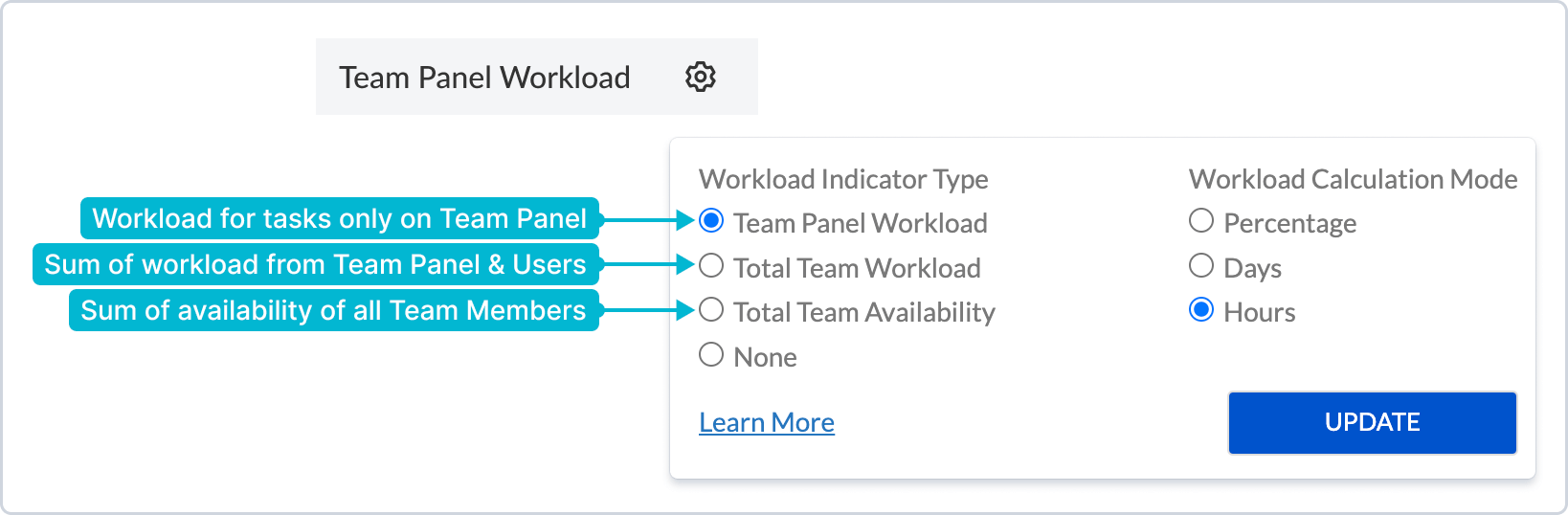
The Team Panel workload indicator can display team capacity and workload in different ways, depending on what you want to analyze.
This guide explains the available workload modes and when to use each of them.
Available modes:
-
Team Panel Workload
-
Total Team Workload
-
Total Team Availability
You can change the workload mode by clicking the cog icon on the Team Panel workload indicator and selecting the preferred mode.
Team Panel Workload
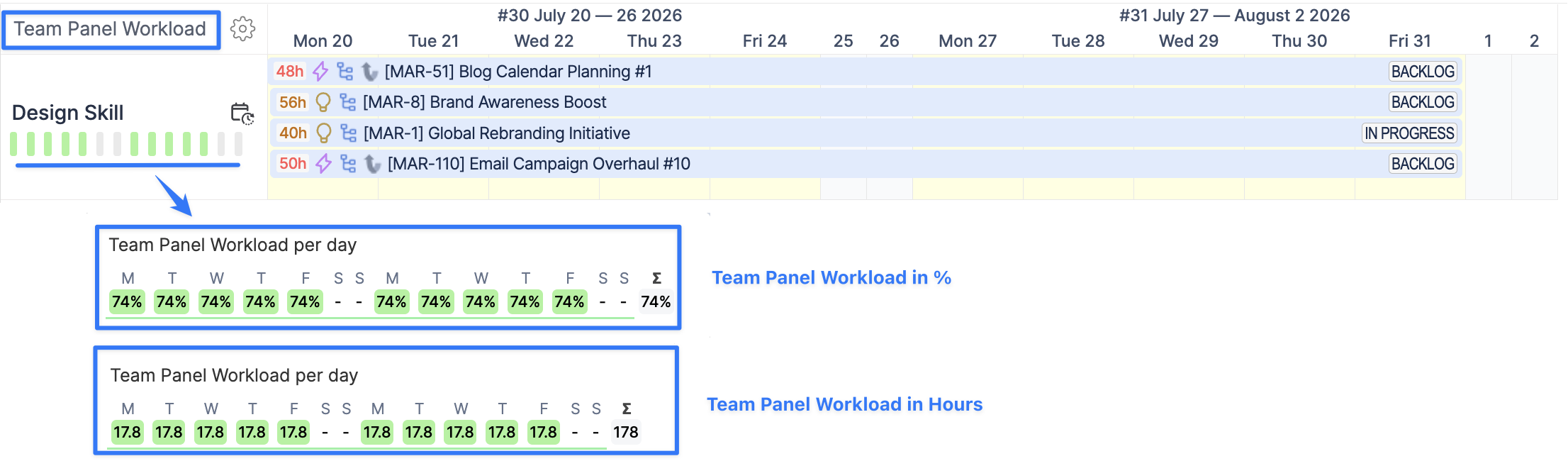
Team Panel Workload shows only the work scheduled directly on the Team Panel.
This mode does not include work already scheduled on individual team members.
In other words, this mode answers the question:
How much work is still planned at the team level and not yet distributed to individuals?
Example
A team has 3 users.
Each user has a daily capacity of 8 hours.
The total team capacity is:
3 users × 8h = 24h/day
For a 2-week sprint with 10 working days, the total team capacity is:
24h × 10 days = 240h
The manager starts sprint planning by scheduling work directly on the Team Panel before assigning it to individual users.
If the team uses a planning target of 75% of total capacity, the manager can plan up to:
240h × 75% = 180h
This means the manager can schedule up to 180 hours of team-level work for the sprint before distributing it to individual team members.
Best Use Cases
Use Team Panel Workload when you want to:
-
plan work at the team level before assigning it to users;
-
track how much work still needs individual allocation;
-
support early-stage planning;
-
reserve team capacity for Epics, initiatives, or future work;
-
avoid mixing team-level planning with individual assignments.
This mode is especially useful for sprint planning, PI planning, portfolio planning, and early project estimation.
Total Team Workload
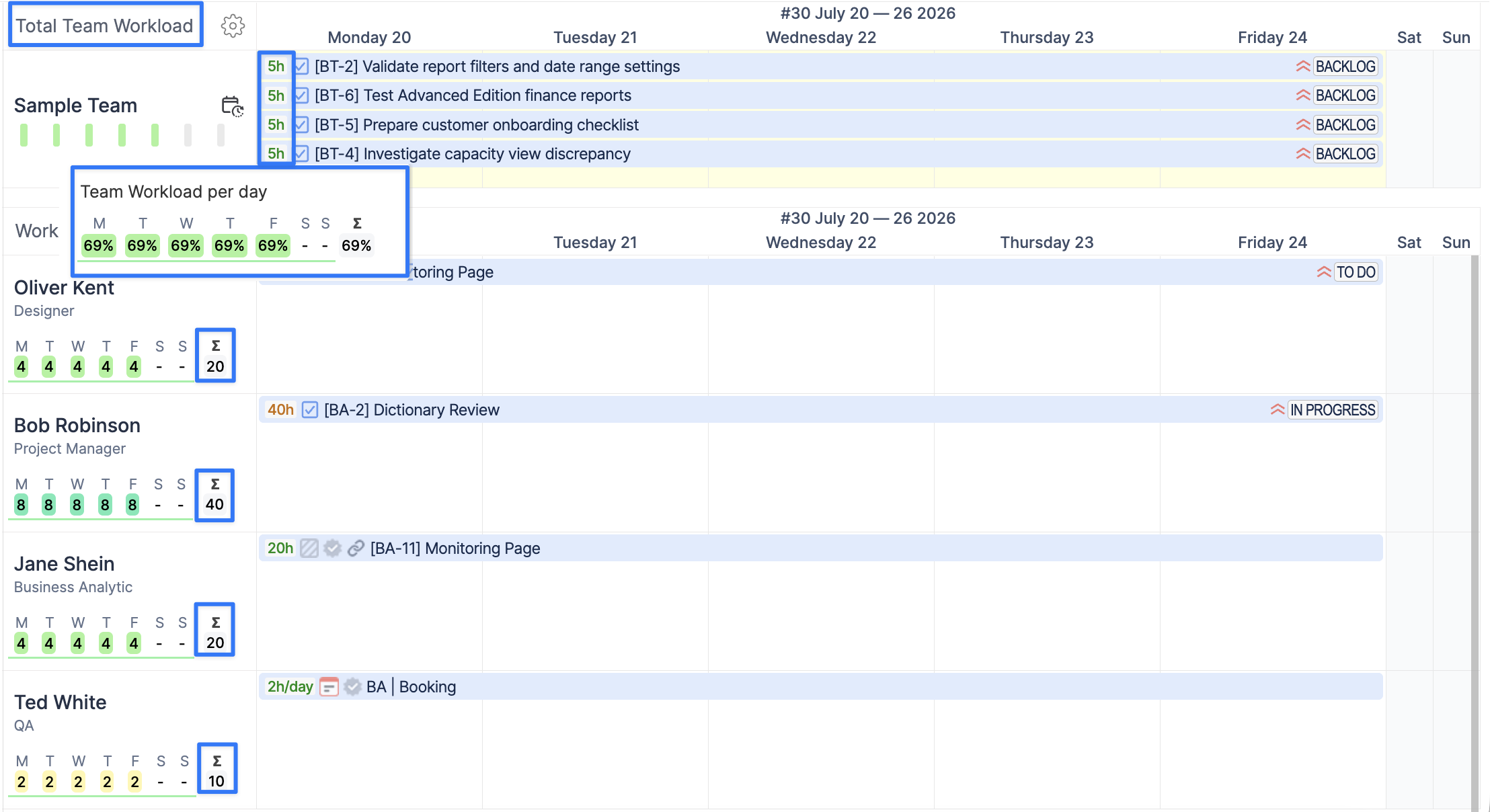
Total Team Workload shows the total amount of work allocated to the team.
This mode includes:
-
work scheduled on individual team members;
-
work scheduled directly on the Team Panel.
In other words, this mode answers the question:
How much work is already planned for this team in total?
Example
A team has 4 users.
Each user works 8 hours per day, or 40 hours per week.
The total team capacity for the week is:
4 users × 40h = 160h/week
During the week:
-
Oliver has 20h scheduled.
-
Bob has 40h scheduled.
-
Jane has 20h scheduled.
-
Ted has 10h scheduled.
-
The Team Panel has 4 unassigned tasks, 5h each.
Team Panel work:
4 × 5h = 20h
Total Team Workload:
20h + 40h + 20h + 10h + 20h = 110h
So the team workload is:
-
110h
-
13.75d
-
69% of total weekly capacity
Best Use Cases
Use Total Team Workload when you want to:
-
understand the full amount of work planned for a team;
-
include both assigned and team-level work;
-
review total team utilization;
-
see how much work is already committed;
-
compare total workload against total capacity.
This mode is useful when some work is already assigned to users, while other work is still planned at the team level.
Total Team Availability
Total Team Availability shows how much capacity the team still has available for the selected period.
This mode takes into account:
-
each team member’s personal capacity;
-
non-working events, such as days off, vacations, sick leave, or holidays;
-
work scheduled directly on team members;
-
work scheduled on the Team Panel.
In other words, this mode answers the question:
How much capacity does this team still have available?
Example
A team has 3 users.
Each user has a daily capacity of 8 hours, so the total team capacity is:
8h + 8h + 8h = 24h/day
On Monday:
-
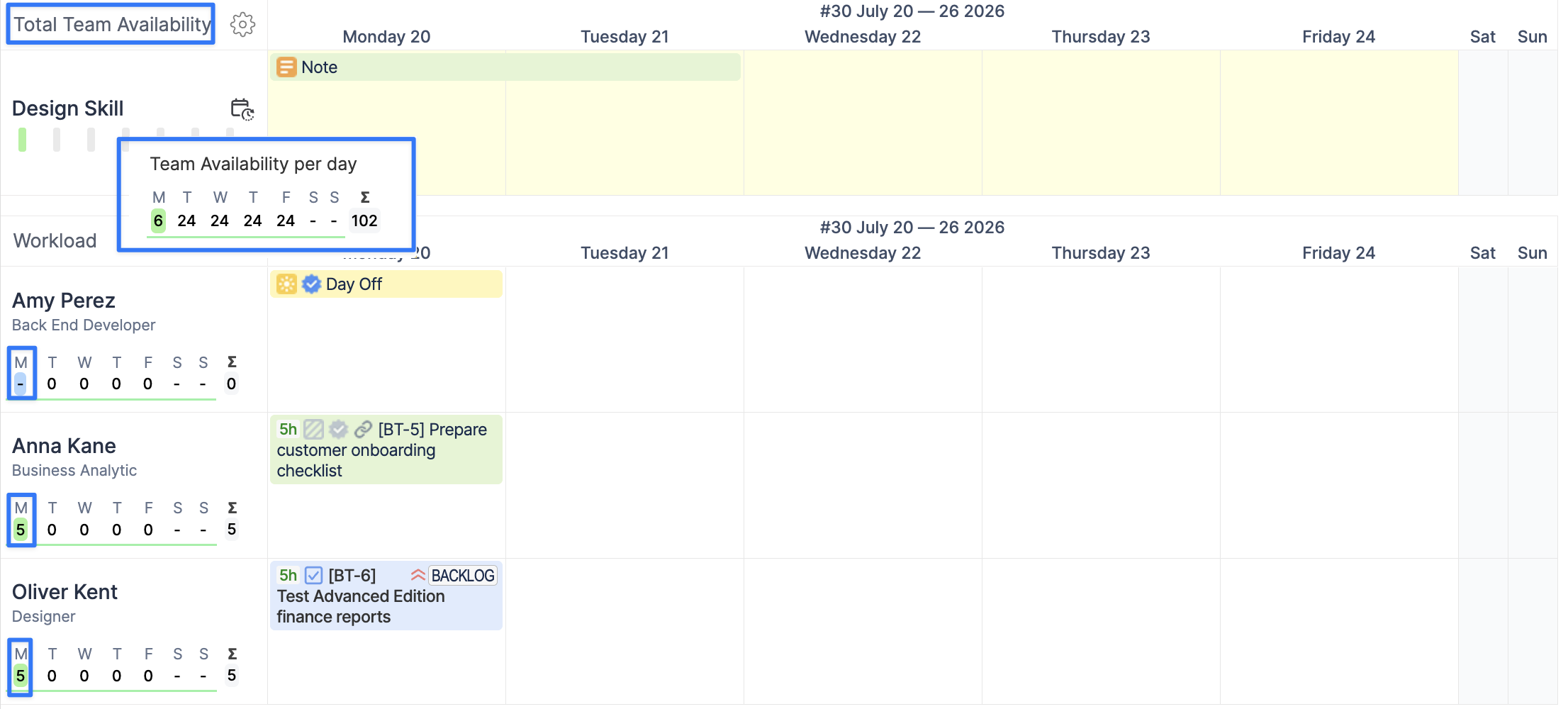
Amy has a full-day Day Off, so 8 hours are removed from the team capacity.
-
Anna has 5 hours of scheduled work.
-
Oliver has 5 hours of scheduled work.
The team’s remaining availability is:
24h - 8h - 5h - 5h = 6h
So the team still has 6 hours available on Monday.
This can also be displayed as:
-
6h
-
0.75d
-
38% availability
Best Use Cases
Use Total Team Availability when you want to:
-
check how much free capacity a team still has;
-
understand whether a team can take more work;
-
compare team availability across days, weeks, or months;
-
avoid overbooking a team;
-
account for absences and existing assignments.
This mode is especially useful for capacity planning and deciding whether new work can be added to the team.
Choosing the Right Mode
|
Workload Mode |
What It Shows |
Best For |
|---|---|---|
|
Total Team Availability |
Remaining team capacity after scheduled work and absences |
Checking whether the team can take more work |
|
Total Team Workload |
All work scheduled on users and the Team Panel |
Reviewing total team commitment |
|
Team Panel Workload |
Only work scheduled directly on the Team Panel |
Pre-planning before assigning work to individuals |