
Overview
The Timeline Timesheet provides a visual overview of logged time across users, projects, Epics, and Jira issues.
Use this view to:
-
Review total logged hours for a selected period.
-
Compare logged time across users.
-
View time by day, week, or month.
-
Identify periods with higher or lower logged hours.
-
Open individual periods for more details.
Depending on the selected template and configuration, color-coded indicators can also help you quickly identify how logged time compares with expected capacity.
Timeline Timesheet Templates
Use predefined templates to quickly organize timesheet data from different perspectives.
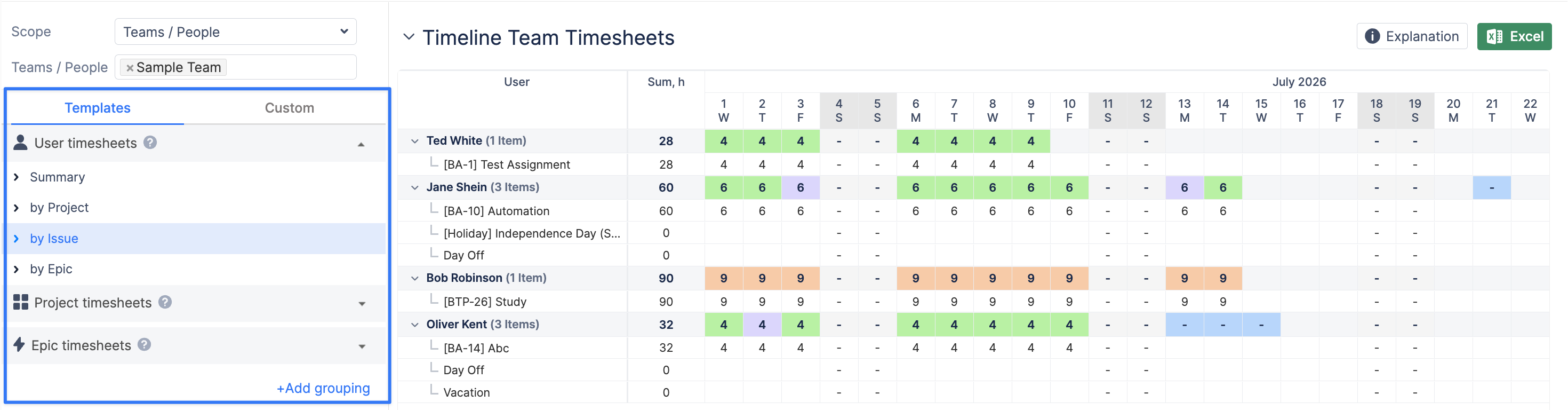
|
Template |
Available Views |
Use it to |
|---|---|---|
|
User Timesheets |
Summary, By Project, By Issue, By Epic |
Analyze how individual users spend their time. |
|
Project Timesheets |
Summary, By User, By Issue, By Epic |
Review time logged across projects and understand who or what contributed to it. |
|
Epic Timesheets |
Summary, By User, By Issue |
Review time spent on larger bodies of work and their related users or issues. |
Summary provides a high-level total for the selected template.
The other views break the data down further by the selected dimension, such as Project, User, Issue, or Epic.
Custom Grouping
If the predefined templates do not match your reporting needs, use the Custom tab to create your own grouping structure.
You can group timesheet data by available Jira fields and create multi-level reports.
Starting from v 15.3.0 you can:
-
Add multiple grouping levels.
-
Reorder grouping levels using drag and drop.
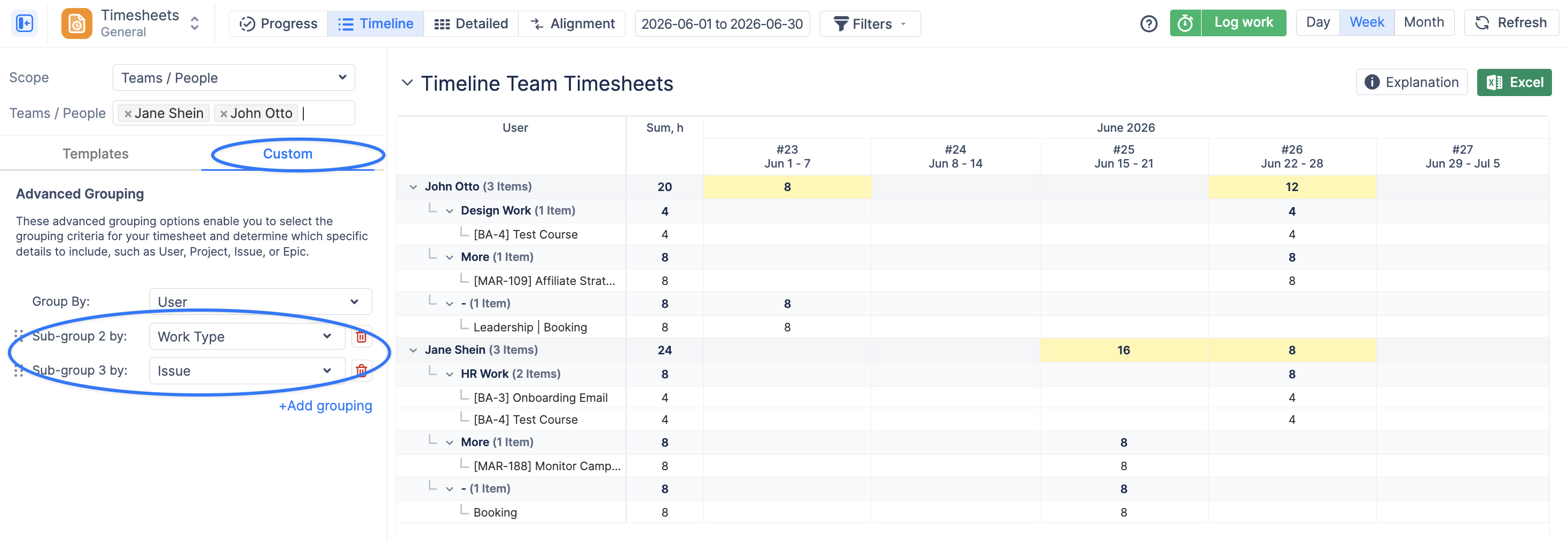
Custom multi-level grouping is available in both Timeline and Detailed Timesheet views.
User Summary Timesheet
The User Timesheets → Summary template provides additional information about each user’s time reporting progress.
In addition to logged hours, the report includes a Progress value that shows how reported time compares with the user’s expected capacity.
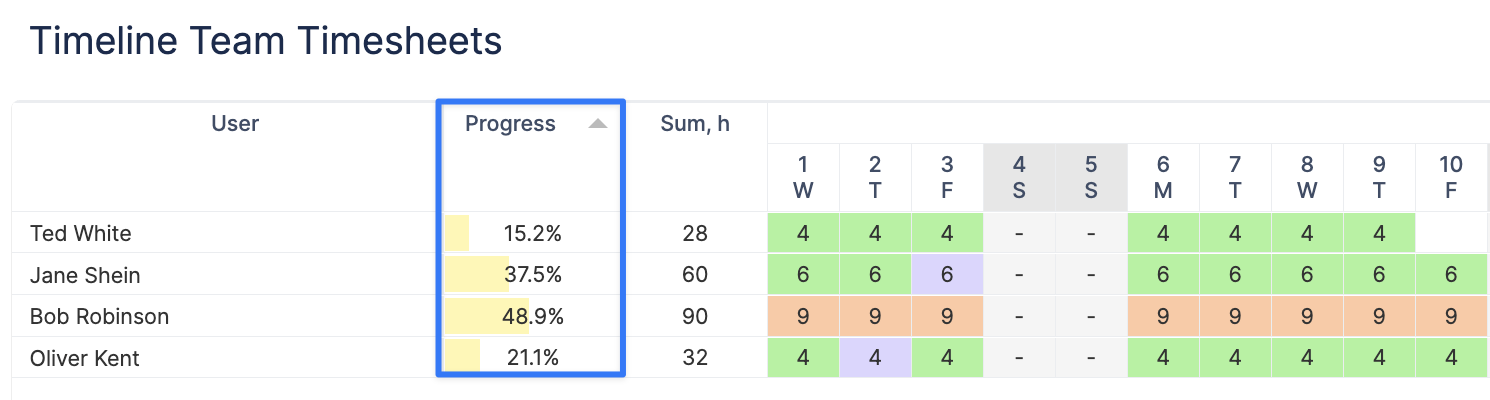
The progress is calculated using the following formula:

*Past bookings mean booking-type events, which are scheduled for the past, and the setting to treat them as worklogs is ON
*Imported External meetings mean meetings imported from Google Calendar
The exact progress calculation depends on your ActivityTimeline Timesheet configuration.
View Worklog Details
The Timeline Timesheet provides several ways to drill down into logged time.
View Worklogs for a User: Click a user’s name to view their worklogs for the selected period.
View Worklogs for a Specific Period: Click a cell in the timeline to view the worklogs recorded for that user and time period. Depending on the selected time unit, the cell may represent a day, week, or month.
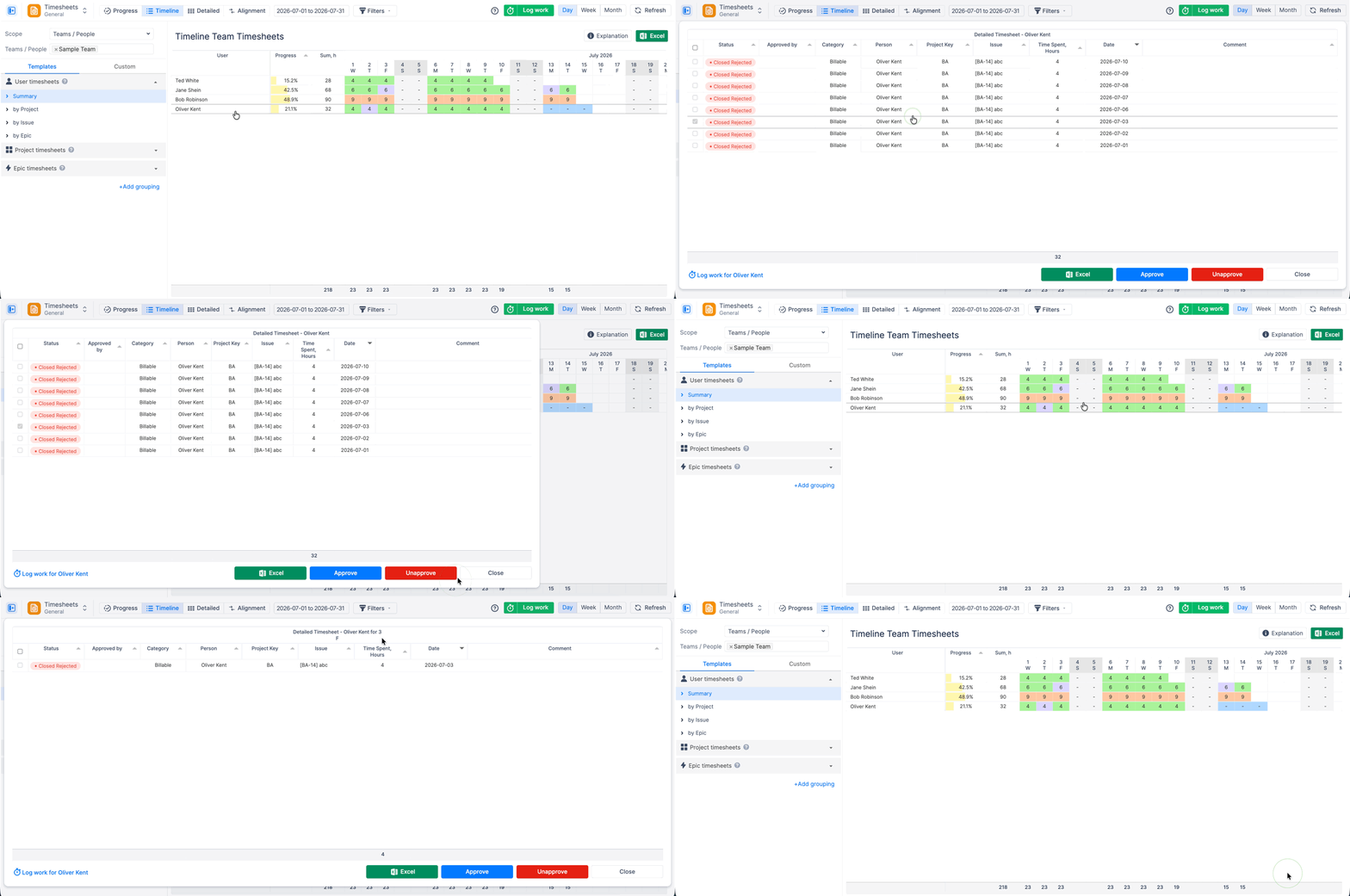
This makes it easier to move from a high-level overview to individual worklog details.
Include Non-Working Days
The User Summary Timesheet can also display information about non-working days.
When this option is enabled, non-working events can be included in the Timeline Timesheet to provide additional context when reviewing users’ logged hours and capacity.
Available columns:
-
DO - Day Off
-
EDO - External Day Off (Imported from Calendar)
-
H - Holiday
-
SL - Sick Leave
-
V - Vacation

This option is managed by an ActivityTimeline administrator in Configuration → Timesheet Configs → Check box ‘Include Non-working events in Timeline Timesheets’.
