
As a resource capacity planning tool, ActivityTimeline uses workload calculations to help teams understand whether users are available, fully booked, or overallocated.
The workload indicator gives managers a quick visual way to review each user’s capacity directly on the Planner. It helps identify underloaded users, prevent overbooking, and adjust assignments before workload issues become critical.
What Is Workload?
There are different interpretations of what workload is, but at its core, it refers to the total amount of work designated to a resource within a specific timeframe.
The easiest way to check the workload is to see the workload indicator that is available under each resource.
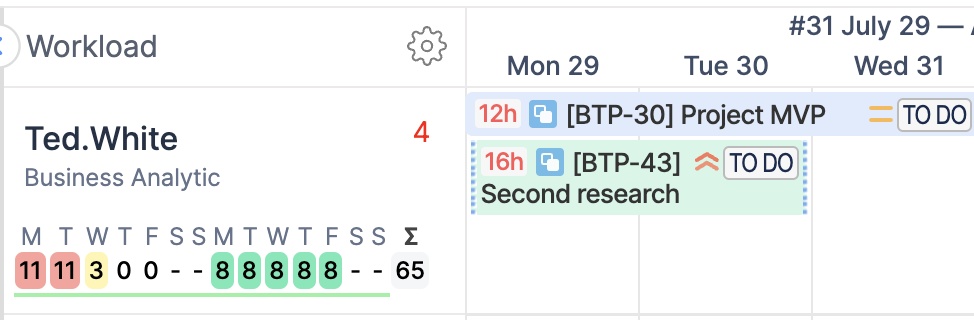
In ActivityTimeline, workload is calculated based on the items scheduled on a user’s timeline, including:
|
Scheduled item |
How it affects workload |
|---|---|
|
Jira tasks |
Calculated based on the task remaining estimate, depending on the selected workload calculation mode. |
|
Calculated based on the estimate and duration assigned to the event. |
By combining these elements, ActivityTimeline provides a clear view of workload distribution, helping teams plan and manage resources more effectively.
What Affects Workload Calculation?
Several settings and data points influence how workload is calculated in ActivityTimeline.
Scheduled Items
Only items scheduled on a user’s timeline in ActivityTimeline affect their workload.
This includes Jira tasks and custom events that have estimates or planned duration.
Task Estimates
For Jira tasks, workload is calculated based on:
|
Estimate type |
How it affects workload |
|---|---|
|
Remaining Estimate |
The remaining work is distributed across the scheduled period according to the selected workload calculation mode. |
|
A fixed amount of work is planned per day for the task. This is useful when the same amount of effort should be reserved each day. |
|
|
Story Points can be included in workload calculations if a Story Point to hours conversion factor is configured. |
ActivityTimeline calculates workload from remaining estimate, daily estimate, or story points, together with custom events scheduled on the user’s timeline.
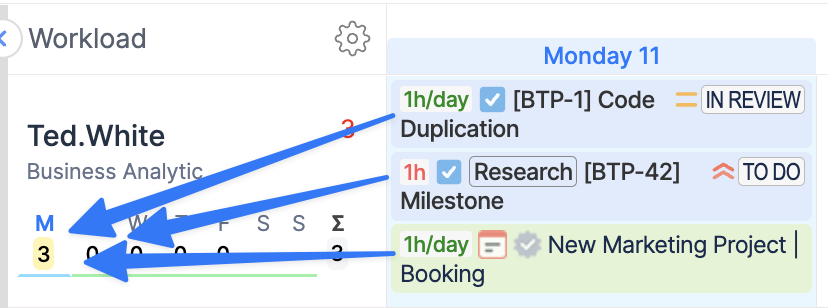
Workload Calculation Mode
ActivityTimeline supports two workload calculation modes: Balance Mode and Liquid Mode.
Both modes use the same task estimates and scheduled dates, but they distribute workload differently across the timeline. In Balance Mode, estimated work is distributed evenly across the scheduled period. In Liquid Mode, the work is allocated according to the user’s available capacity or involvement.
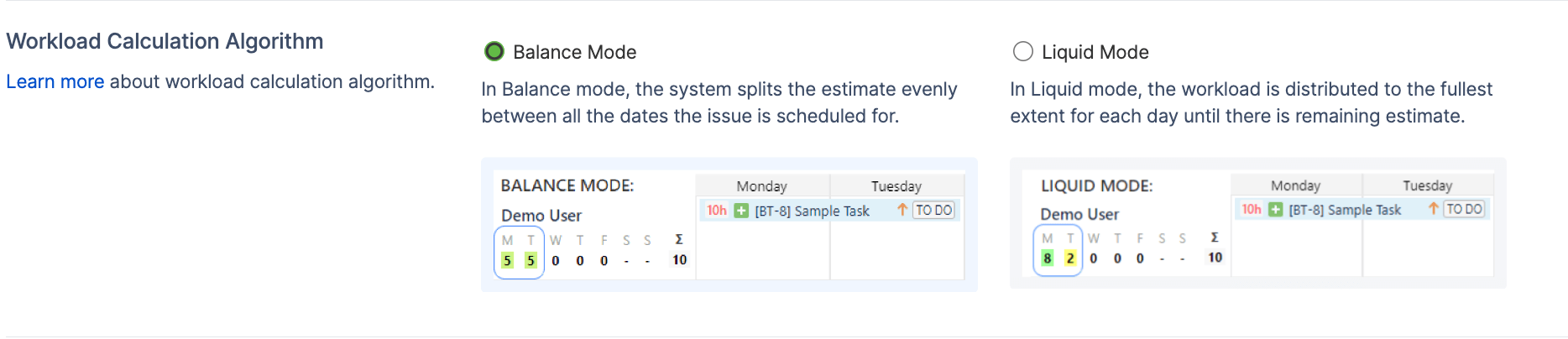
The selected mode is configured by an ActivityTimeline Administrator and affects how workload indicators are calculated in the Planner.
For more details, see the Configure Workload Calculation documentation.
Time-Tracking Settings
The Time Tracking Mode defines how ActivityTimeline treats planned workload and logged time.
This setting is configured by an ActivityTimeline Administrator and should match how your team works: whether users regularly log worked time or use ActivityTimeline mainly for planning and forecasting.
For more details, see the Configure Time Tracking and Workload documentation.
User Capacity and Involvement
Workload is also affected by the user’s working schedule, daily working hours.
For example, if a user has part-time involvement or reduced availability, the same amount of scheduled work may represent a higher workload percentage compared to a full-time user.
For more details, see the User Capacity (Involvement) documentation.
Non-Working Events
Events such as Day Off, Vacation, Sick Leave, or Holidays reduce the user’s available capacity.
These events are reflected in the workload indicator and help managers avoid scheduling work during non-working periods.
For more details, see the Time Off Management (Holidays, Vacations, Sick Leaves, Days Off) documentation.
Workload Indicator Color
Workload indicator has eight main colors to help managers and teams have better visibility of a person's availability.
-
blue - out of the office; Day Off, Vacation, Sick Leave, or Holiday is scheduled on a user
-
yellow - workload is not enough (less than 50% h/day) and some additional tickets can be added to a timeline
-
olive - workload is not enough (between 50-87% h/day) and some additional tickets can be added to a timeline
-
green - workload is enough (between 88-100% h/day), no more tickets can be scheduled on a timeline
-
light red - a person is overloaded (between 100-125% h/day) and some tickets have to be re-scheduled for another day
-
red - a person is overloaded (more than 125% h/day) and some tickets have to be re-scheduled for another day
-
purple - Day Off, Vacation, Sick Leave, or Holiday is assigned on Logged time or weekend
-
grey - workload is "0" h/day; no workload is displaying on that day
These color ranges can be customized by an ActivityTimeline Administrator in:
Configuration → Workload Indicator → Workload Indicator Color Range Customization

Workload Indicator Values by Timeline Scope
The workload indicator adapts to the selected timeline scope.
In the default Week scope, the workload indicator shows the user’s workload or availability for each day of the selected week.
When switching to longer scopes, ActivityTimeline summarizes workload values by the selected period. For example, the indicator may show totals by week or by month.
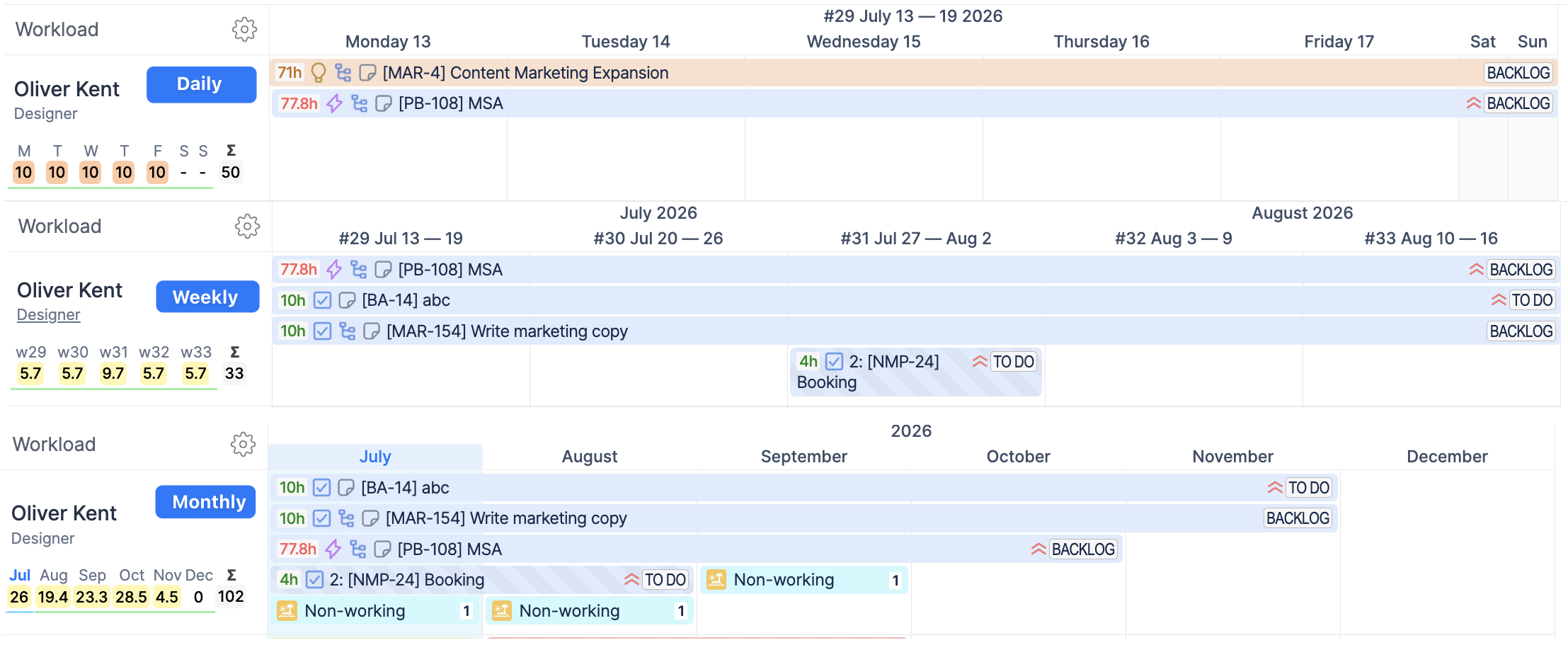
In compact or long-term views, the workload indicator may be displayed in a shortened format. Hover over the indicator to view additional details.
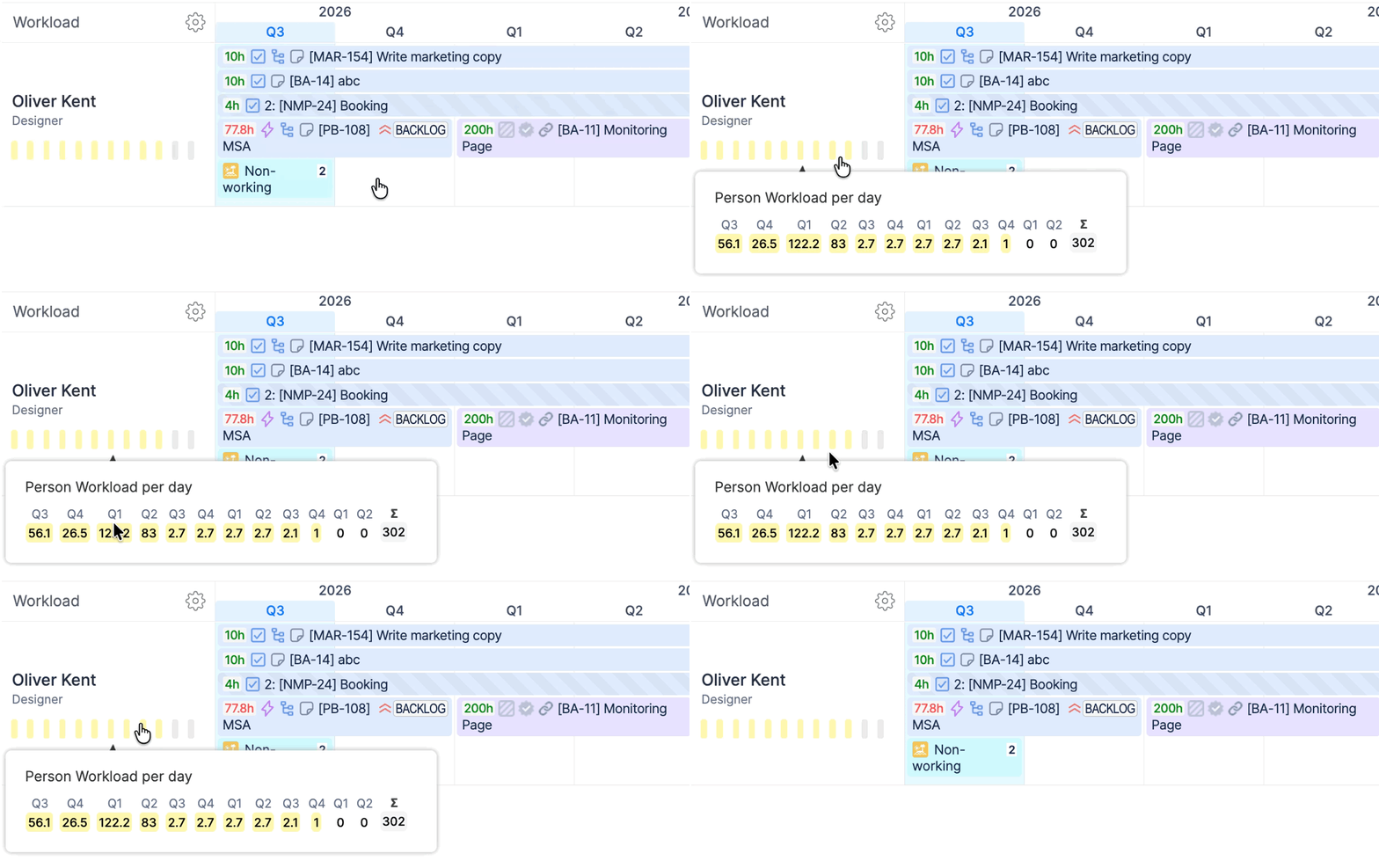
For more details, see the Planning Period, Units and Compact Mode documentation.
Disabling the Workload Indicator
If you do not want to display the workload indicator on the Planner, it can be disabled by an ActivityTimeline Administrator.
To disable it, go to:
Configuration → Workload Indicator → Show Workload Indicator
Then turn off the option