
What is a Placeholder?
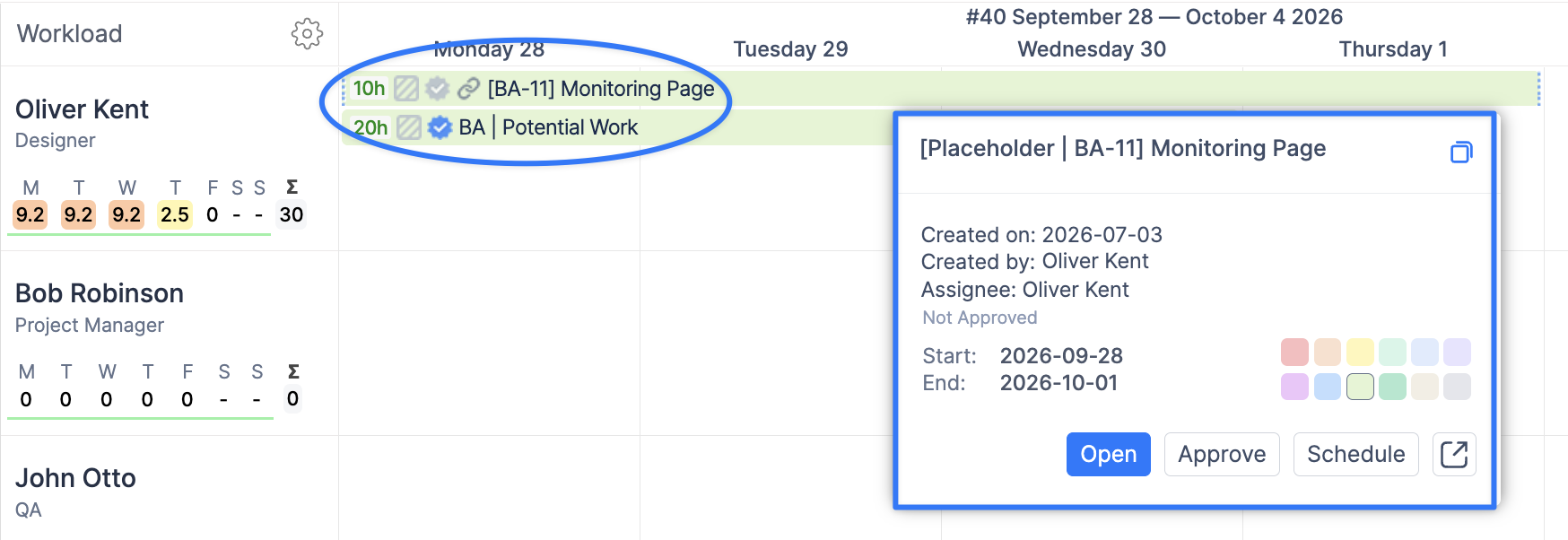
A Placeholder is one of the custom event types in ActivityTimeline. It is used for high-level or tentative planning before the work is finalized in Jira.
Placeholder events can be created as standalone planning items or linked to existing Jira issues.
What are Placeholders used for?
Placeholders are useful when managers want to explore different planning scenarios without immediately updating Jira issue data.
They can be used for:
-
tentative assignments;
-
future project phases;
-
resource demand planning;
-
work that is not ready to be assigned yet.
Unlike Bookings, where time is estimated per day, Placeholders use one total estimate for the full event duration. This makes them better suited for broader planning, while Bookings are more precise and focused on daily resource allocation.
Creating a Placeholder for a Jira Issue
There are two ways to add a Jira issue to the timeline as a Placeholder.
Option 1: Drag from the Issues Panel
Drag an issue from the Issues Panel and drop it onto a user’s timeline while holding:
-
Ctrl on Windows;
-
Command on macOS.
This creates a Placeholder, but does not schedule the actual Jira issue.
If the issue is dragged without holding Ctrl/Command, ActivityTimeline will schedule the Jira issue directly, update the assignee, and set the start and end dates in Jira.
If a ticket is dragged without the Control/Command key pressed, the system will schedule a Jira task, change the assignee, and set the start and end dates
Option 2: Create from the Timeline
Click a cell on the timeline and select:
Placeholder
Then choose one of the following options:
-
select a project and estimate to create a new Placeholder;
-
choose Create Placeholder for existing Jira Issue;
-
find the issue using Quick Issue Search;
-
click Create.
Managing a Placeholder
From the timeline, a manager can update the Placeholder schedule, estimate, or assignee.
These changes apply only to the Placeholder and do not update the linked Jira issue. No changes will be shown on the Jira issue until the Placeholder is approved.
Approving a Placeholder
Once a Placeholder is ready to be converted into planned Jira work, it can be approved.
You can approve it by either:
-
clicking the Approve icon;
-
selecting Approve from the Placeholder card.
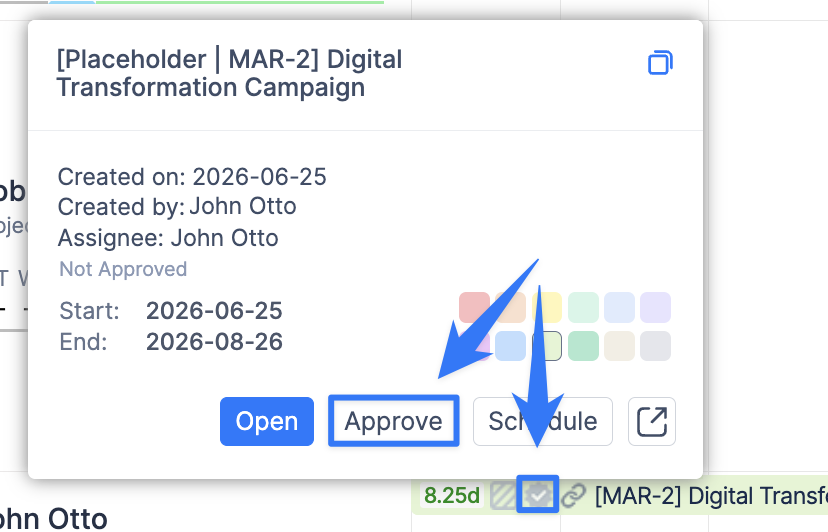
Once approved, ActivityTimeline automatically replaces the Placeholder with the corresponding Jira issue.
The Jira issue is then assigned to the user whose timeline the Placeholder was scheduled on.
For bulk approval, see the relevant bulk approval guide: Bulk Reschedule.
Issue bar can display the number of placeholders associated with a task, making it easy to identify work that still requires resource allocation. You can enable it under Configurations -> Issues -> Check 'Issue Placeholder Icon' -> Click 'Update'.
Once enabled click the placeholder icon to instantly view all placeholders linked to the issue.
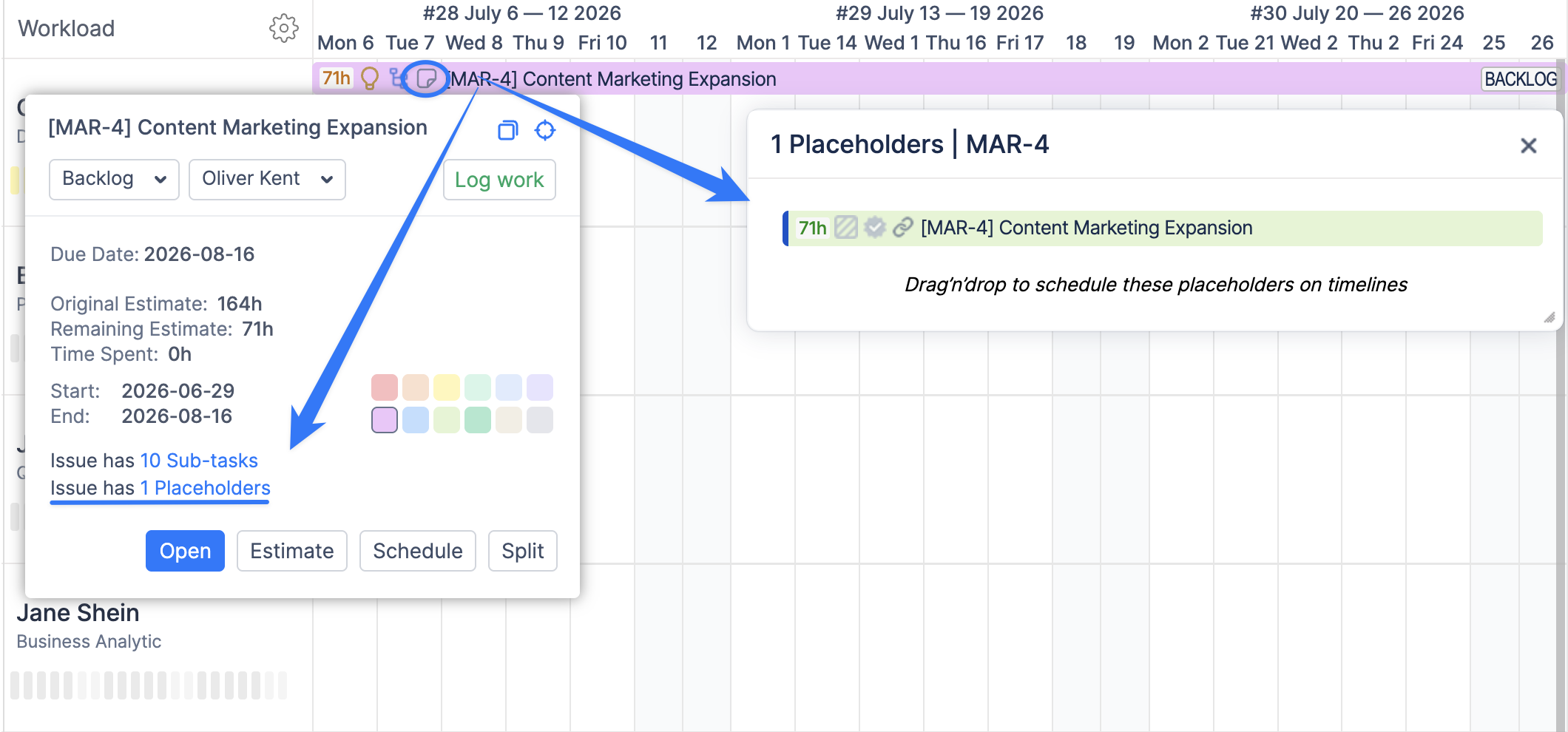
The issue details card also shows the total placeholder count, giving managers and team leads better visibility into outstanding planned work and resource demand.
Creating a Placeholder without a Jira Issue
You can also create standalone Placeholders that are not linked to any Jira issue.
For more details, see:Creating a Placeholder without a Jira Issue
FAQ
Q: Does a Placeholder create or update a Jira issue?
A: A Placeholder does not update the Jira issue while it is being planned.
Managers can change the placeholder’s dates, estimate, or assignee directly on the timeline. These changes apply only to the Placeholder and do not affect the linked Jira issue.
A Jira issue is updated only when the Placeholder is approved.
Q: Can one Jira issue have multiple Placeholders?
A: Yes. One Jira issue can have multiple Placeholders linked to it. This is useful when the same issue needs to be planned across several users, teams, or time periods before the final assignment is confirmed.
The issue card can display the number of linked Placeholders, making it easier to identify work that still requires resource allocation.
To enable this indicator, go to:
Configuration → Issues → Issue Placeholder Icon → Update
Once enabled, click the placeholder icon on the issue card to view all Placeholders linked to that issue.
Q: What happens if I delete a Placeholder?
A: Deleting a Placeholder removes only the planning item from ActivityTimeline. It does not delete or modify the linked Jira issue.
Q: Who can create and approve Placeholders?
A: By default, users can create and manage Placeholders for themselves or other users (Depending on the role). Users with Read-only access cannot create or modify Placeholders.
Placeholder approval is available to users with the required permissions, such as Team Leads, Managers, or Administrators. The available actions depend on the user’s ActivityTimeline role.