
Time off in ActivityTimeline is managed through non-working events.
Non-working events are used to mark periods when team members are not available for project work, such as vacations, sick leave, days off, or public holidays. These events reduce the user’s available capacity, helping managers plan work more accurately and avoid overbooking.
When a non-working event is added to a user’s timeline, ActivityTimeline updates the workload indicator and recalculates the user’s availability for the selected date or period.
Types of Time Off Events
ActivityTimeline includes several event types for managing time off.
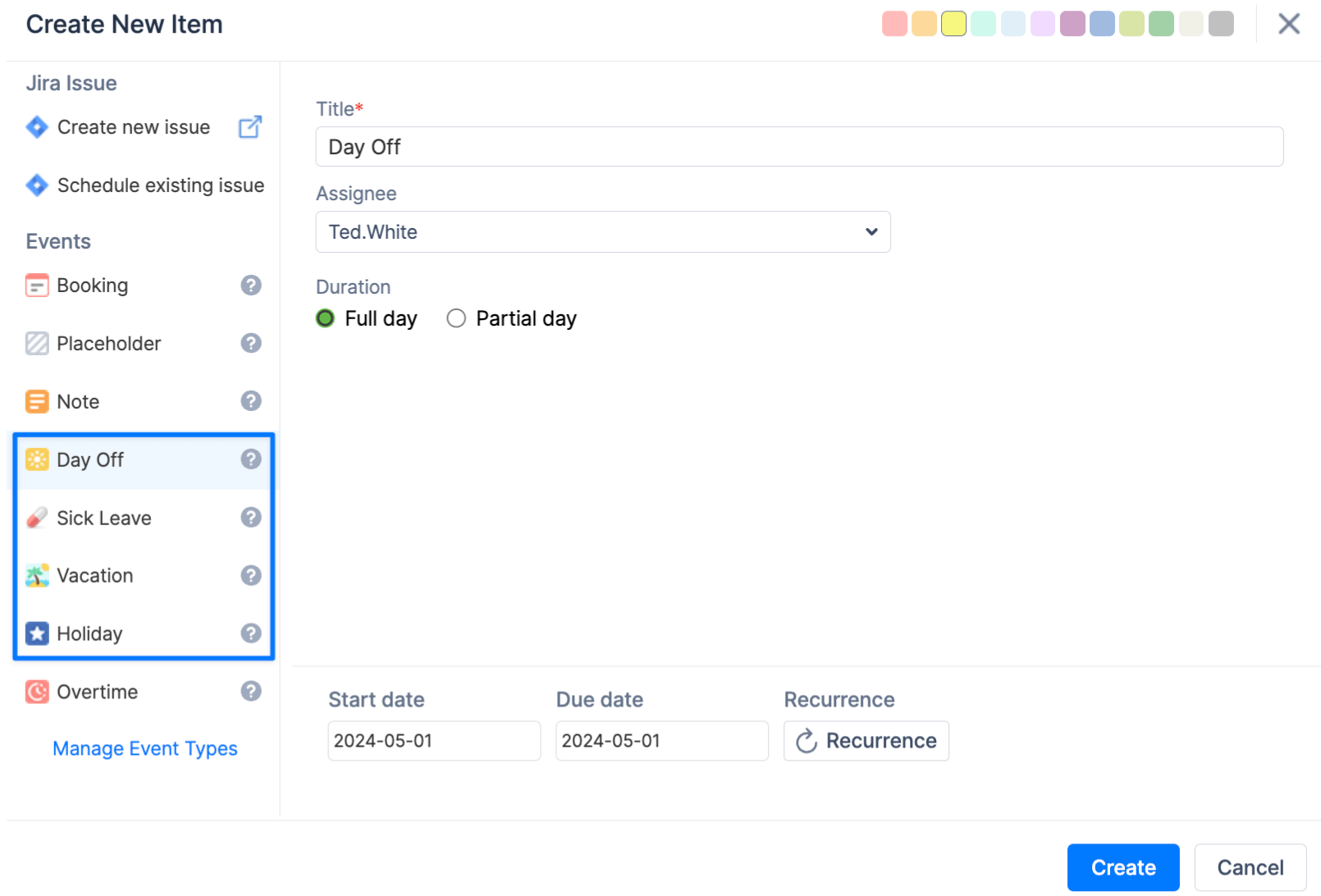
Day Off
A Day Off event excludes the selected time from the user’s capacity.
The system does not allocate workload to the period marked as Day Off.
A Day Off can be created as:
-
Full day off — removes the full daily capacity;
-
Partial day off — removes a specific number of hours from the user’s capacity.
Sick Leave
A Sick Leave event is used to track days when a user is unavailable due to medical reasons.
Vacation
A Vacation event is used to track planned user vacations.
Managers or administrators can approve vacation events to prevent further changes by users without the required permissions.
A Vacation can be created as:
-
Full day off — removes the full daily capacity;
-
Partial day off — removes a specific number of hours from the user’s capacity.
Learn more about Vacation Management.
Holiday
A Holiday event is used to mark public holidays and official non-working days.
Holiday events can be created manually or automatically through Holiday Schemes.
Learn more: Holidays Schemes .
Creating a Time Off Event
To create a time off event:
-
Open the Planner or Workspace.
-
Click the required date on the user’s timeline, or click the New Task button in the top-right corner.
-
Select the required event type, for example Day Off, Vacation, or Sick Leave.
-
Select the person and date, if needed.
-
Choose whether the event is a Full day off or Partial.
-
For partial time off, enter the number of hours.
-
Click Create.
Once the non-working event is created, the user’s capacity is reduced for the selected date or period.
How Time Off Affects Workload
When a non-working event is added to the timeline, ActivityTimeline updates the workload indicator to reflect the user’s reduced availability.
For a full-day non-working event, the workload indicator for that day may show that no capacity is available.
If Jira issues or other work were already scheduled for that day, ActivityTimeline recalculates workload and availability based on the updated capacity and the configured workload calculation settings.
For example, if a user has an 8-hour daily capacity and a full-day Day Off is added for Monday, the user’s available capacity for Monday becomes 0 hours. Any remaining workload may be redistributed to other available working days depending on the task schedule and workload calculation settings.

This helps managers immediately see how time off affects the user’s workload and project plan
Managing Time Off Event Types
ActivityTimeline administrators can manage available event types, rename existing types, customize their appearance, or create new event types based on company needs.
Learn more: Custom Event Types .